




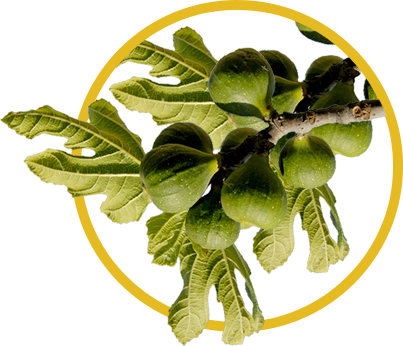
Figs
The figs have many other names in Russian and Armenian. The term fig refers not only to the fruits but also to the tree on which they grow. The fig is believed to be one of the oldest cultural plants. Initially it was cultivated in Arabia and only then it began to be cultivated in Syria, Phoenicia and Egypt. The fig is a subtropical tree, which belongs to the mulberry family and can grow up to 12 meters in height. The tree has very developed root system. The figs contain huge amounts of group B vitamins (В1, В2, В3, В6, РР), the beta-carotene, cellulose, pectin, mineral salts of iron, potassium, magnesium and calcium.
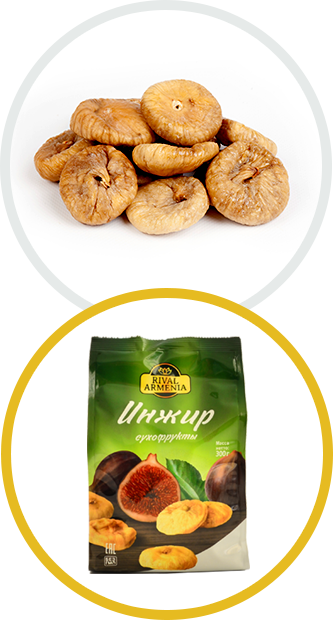
Dried figs
Dried figs have light-beige color and round shape flattened from one side. The pulp is viscous with many small bones. It is very sweet and slightly astringent but without excessive mawkishness. The dried fig has high concentration of carbohydrates, proteins, fats and sugars. Dried fruits fill the body with energy, give strength, and ensure good mood.
The nutritional facts of dried figs differ from that of the fresh fruits, as the concentration of water in dried fruits reaches its minimum and that of sugars increases up to 70%. The concentration of vitamins and minerals in dried and fresh fruits is almost the same.
The content and the useful properties: the figs contain huge amounts of microelements: copper, iron, magnesium, calcium, potassium, and vitamins A and B. Due to the high concentration of potassium, these fruits are very useful for people suffering from cardio-vascular diseases helping to relax and expand the vessel walls. The figs are used to fight the hypertension and venous insufficiency. Due to the content of ficin enzyme, the figs reduce the blood clotting and help to dissolve vascular clots. Besides, these fruits have laxative effect. They are irreplaceable for fighting the overweight, hangover, stress and cough. The fig does not allow the sugar to transform into fat. It is highly recommended especially for those who suffer from cardiovascular and vessel problems. The ficin enzyme helps to fight thrombosis.
In order to get 300g of dried figs, 1200g of fresh fruits are used. The figs are grown on our own plantations, which are located 15 kilometers from Yerevan. Due to the innovative technology of drip irrigation, the trees get the optimal quantity of humidity. This results in ecologically clean, healthy and tasty harvest, which is then used for the production of delicious and useful dried figs without preservatives and GMO. The figs have to be preserved in dry, clean and cool place at a temperature of +5 to +25°С and relative humidity of no more than 70%. The shelf life of the product is 12 months.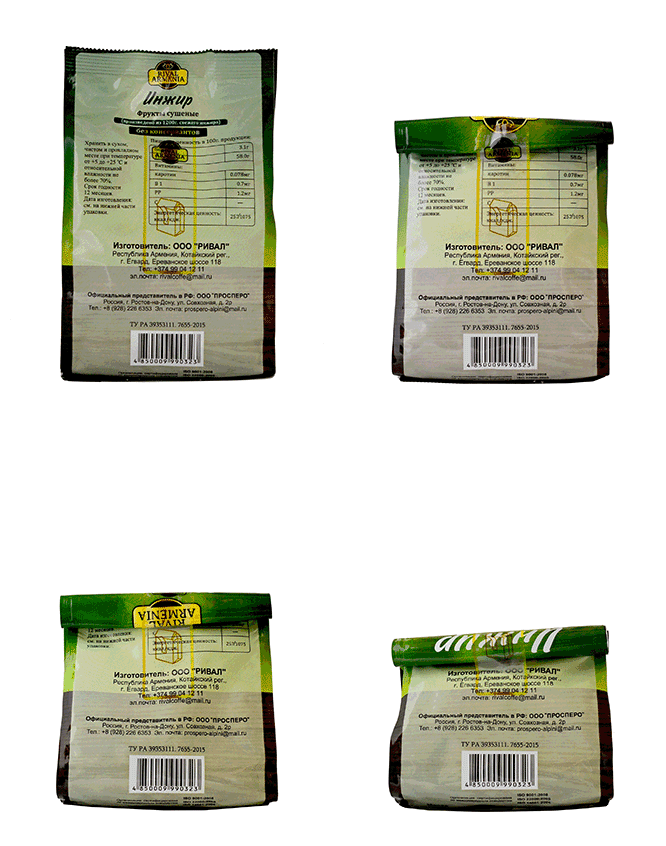
Packing
The figs are packed in three-layer polymer film with an aluminum base, which protects products from mold formation and maintains the freshness of the product.
Unlike the cellophane package, the polymer film does not allow the humidity which is destructive for the dried fruits. The packaging is useful for both disposable and repetitive use due to the Velcro-tape attached on the reverse side of the package.Proteins 3.1g Carbohydrates 58.0g Vitamins: Carotene 0.078mg B1 0.7mg PP 1.2mg C - Energetic value: Kcal/kJ 257/1075

